
Structured Postal Addresses in SWIFT CBPR+: Why ISO 20022 Compliance Starts with Address Data
Updated: Mar 1
SWIFT CBPR+ structured postal addresses are more than a formatting requirement — they are a critical pillar of ISO 20022 compliance. As global migration accelerates toward the November 2026 deadline, banks, payment service providers (PSPs), and corporates must replace unstructured or hybrid address formats with fully structured data. This guide explains what structured postal addresses are, why they matter, and how to implement them in your SWIFT CBPR+ environment.
As the global ISO 20022 migration accelerates, financial institutions can no longer rely on unstructured or loosely structured address fields. Banks, PSPs, and corporates must be capable of sending, receiving, validating, and screening fully structured postal addresses across the payment lifecycle.
This guide explains:
What structured postal addresses are in SWIFT CBPR+
Why they matter for compliance and risk reduction
Which systems are impacted
How institutions should plan and execute the transition
What Are Structured Postal Addresses in SWIFT CBPR+?
Under ISO 20022 and the SWIFT CBPR+ programme, postal addresses are broken into discrete, machine-readable elements, such as:
Street name
Building number
Town / city
Post code
Country (ISO country code)
This replaces legacy MT formats where addresses were transmitted as free-text lines, often inconsistent, truncated, or reordered.
SWIFT CBPR+ guidelines strongly encourage the use of fully structured address components, with hybrid formats allowed only as a transitional measure.
Why Structured Addresses Matter More Than Ever
1. Sanctions Screening & AML Accuracy
Unstructured address data leads to:
High false positives
Missed sanctions matches
Manual compliance reviews
Structured addresses dramatically improve name and address matching precision, enabling smarter sanctions and fraud screening.
2. End-to-End Interoperability
ISO 20022 is designed for straight-through processing (STP). Structured address elements ensure:
Data survives correspondent hops
No loss during format translations
Predictable downstream processing
3. Regulatory Expectations
Regulators increasingly expect high-quality, structured data to support:
AML investigations
Travel Rule compliance
Cross-border transparency
Hybrid Addresses: A Transitional Reality

Even if your institution plans to move toward fully structured addresses, hybrid addresses are unavoidable today.
Banks must:
Accept hybrid address formats from correspondents
Allow customers to submit them
Validate them correctly during processing
Key point: ISO 20022 compliance requires the ability to accept and process hybrid addresses — not just generate structured ones.
Systems That Must Support Structured & Hybrid Addresses
To comply with SWIFT CBPR+ requirements, banks must update multiple layers of their technology stack, including:
Customer-Facing Channels
Online and mobile banking
Corporate bulk payment file uploads
API and Open Banking integrations
Customer service and operations tools
These systems must collect, validate, and store address components correctly at source.
Impact Analysis: What Systems Are Affected?
The move to structured and hybrid addresses impacts the entire payment value chain.
1. Customer-Facing Systems
Onboarding journeys
Payment initiation screens
File upload validations
Poor address handling here leads to downstream rejections and delays.
2. ERP & Treasury Management Systems (TMS)
Most ERP and TMS platforms store addresses in unstructured text fields, requiring:
Data model changes
File format upgrades
Mapping to ISO 20022 address elements
3. Back-Office & Payment Processing
Payment engines
Core banking systems
Message translation layers
Correspondent banking interfaces
All must support hybrid validation rules aligned with CBPR+.
4. Risk & Compliance Platforms
Sanctions screening
Fraud detection
Regulatory reporting
These systems depend heavily on address data quality for accuracy and explainability.
Assessing and Updating Your Systems
ERP & TMS Limitations
Most legacy ERP and treasury platforms were never designed for structured addresses. Institutions must:
Extend schemas
Enable hybrid storage models
Preserve backward compatibility where needed
Validation Rule Updates
If your current controls only accept:
Fully unstructured or
Fully structured addresses
They must be reconfigured to support hybrid address logic, as defined by SWIFT CBPR+.
Compliance & Correspondent Readiness
Incoming transactions from:
Correspondent banks
Clearing houses
Market infrastructures
Must be processed without rejection due to address formatting issues.
The Challenge of Migrating Existing Customer Address Data
Retrofitting existing customer records into structured or hybrid formats is not trivial.
Risks include:
Disrupting statement and cheque deliveries
Breaking downstream postal workflows
Introducing inconsistencies across systems
A phased, non-destructive migration strategy is essential — one that enriches data progressively without overwriting trusted operational records.
Preparing for the November 2026 ISO 20022 Milestone
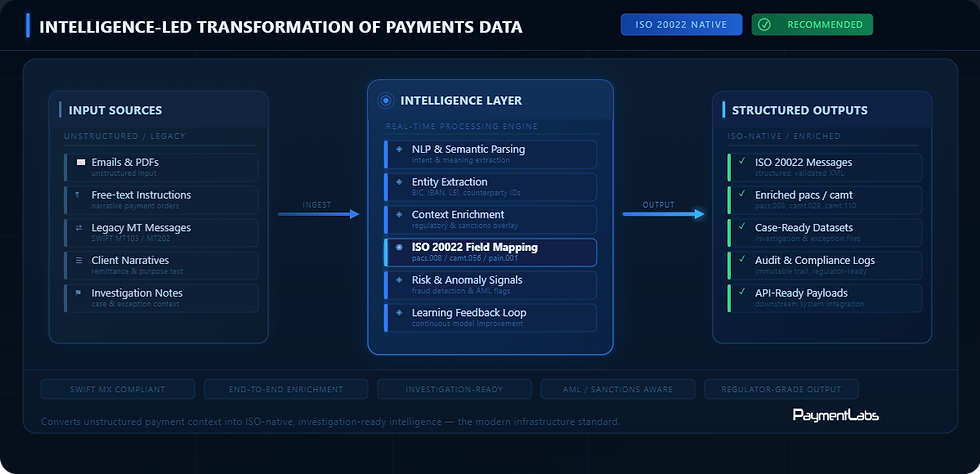
The November 2026 deadline marks a critical point where expectations around data quality will significantly tighten. Institutions that delay structured address readiness risk:
Higher repair rates
Compliance friction
Payment delays and rejections
Our white paper, "The Role of Structured Postal Addresses in ISO 20022," provides actionable insights to simplify your transition. Inside, you will learn:
✅ Why Structured Postal Addresses Matter: Improve compliance, reduce false positives, and strengthen cross-border transparency.
✅ Hybrid Addresses Explained: How to balance real-world banking constraints with future ISO 20022 expectations.
✅ Key Deadlines & Regulatory Timelines: What banks must be ready for by November 2026 and beyond.
✅ Machine Learning–Driven Migration How the Nucleus ISO 20022 Data Fabric automates address parsing, validation, enrichment, and quality scoring at scale.
About Payment Labs
Payment Labs is a specialist financial technology firm helping banks, PSPs, and corporates navigate the ISO 20022 migration. Our Nucleus ISO 20022 Data Fabric platform provides end-to-end data transformation, address enrichment, and compliance automation for SWIFT CBPR+, SEPA, and domestic payment schemes.
For implementation support, system assessments, or to request a demo, contact our ISO 20022 advisory team.
Last updated: March 2026 | Payment Labs ISO 20022 Compliance Series