
SWIFT IPLA and SIL Retirement: The Complete 2026 Guide for Banks and Financial Institutions
Swift is retiring IPLA (the Alliance Access Integration Platform) and SIL (the Swift Integration Layer) on June 30, 2026, with no extension currently announced. These are the legacy middleware tools that connect a bank's internal systems — payments, sanctions screening, AML, core banking, treasury, and ERP platforms — to the Swift network, translating, routing, and validating MT and MX messages. After the deadline, Swift will no longer support either product, meaning every institution still running them needs a replacement integration strategy already in place.
This is rarely a like-for-like swap: most banks built years of message-transformation logic, routing rules, and compliance workflows directly into IPLA and SIL, so migration touches far more than Swift connectivity alone.Key Takeaways
Swift's IPLA and SIL retirement deadline is June 30, 2026 — a firm, network-wide date with no publicly announced grace period.
IPLA and SIL aren't just Swift connectors. They frequently sit at the center of AML, sanctions screening, fraud detection, and core banking integration — so the scope of migration is usually larger than it first appears.
The retirement is one piece of Swift's broader shift toward API-first, cloud-native, ISO 20022-ready infrastructure, alongside Swift's cloud-based connectivity service introduced in 2020.
This affects all of Swift's roughly 11,500 member institutions still running this middleware, regardless of size.
Institutions have several migration paths: direct API/cloud connectivity, like-for-like middleware replacement, a centralized orchestration platform, or a phased hybrid approach.
The biggest risk isn't the deadline itself — it's underestimating how much is wired through IPLA/SIL and starting the audit and rebuild process too late to test properly.

Table of Contents
What Is IPLA in Swift?
What Is SIL in Swift?
IPLA vs. SIL: What's the Difference?
Why Is Swift Retiring IPLA and SIL?
When Is the SWIFT IPLA and SIL Deadline?
Who Is Affected?
The Real Challenges of IPLA/SIL Migration
What Happens If You Don't Migrate in Time?
Migration Options Compared
A Step-by-Step Migration Roadmap
Common Mistakes to Avoid
Frequently Asked Questions
How Payment Labs Helps
What Is IPLA in Swift?
IPLA, the Alliance Access Integration Platform, is middleware embedded within Swift Alliance Access that acts as a message-transformation and routing layer. It converts financial messages between a bank's internal proprietary formats and Swift standards — including MT, MX, and ISO 20022 — and supports multiple communication protocols so that legacy back-office systems can interact with Swift's network for cross-border payments, securities trades, and trade finance. In short, IPLA sits inside Alliance Access and does the heavy lifting of message translation and routing so internal systems don't have to speak Swift's formats directly.
What Is SIL in Swift?
SIL, the Swift Integration Layer, performs a similar job to IPLA but as a standalone integration layer, separate from Alliance Access. It connects internal applications — payment gateways, ERP systems, treasury platforms — to Swift's messaging services without requiring changes to those existing applications. SIL handles data transformation to bring proprietary formats into compliance with Swift's standards, manages message routing, and enforces Swift's security protocols. Its lighter footprint made it attractive to institutions that wanted Swift connectivity without a full Alliance Access deployment.

In practice, the two are often discussed together because they solve the same underlying problem — bridging internal systems and Swift — and both are being retired on the same timeline.
Why Is Swift Retiring IPLA and SIL?
Swift's decision reflects a broader strategic shift across the network, not a routine product sunset. Several forces are driving it:
ISO 20022 migration and structured data. The global move to ISO 20022 lets messages carry far richer, structured information — detailed remittance data, purpose codes, compliance attributes — that improves reconciliation, fraud detection, and regulatory screening. IPLA and SIL were built for older MT-style messaging and can't natively process ISO 20022 without heavy customization, which creates both inefficiency and compliance risk.
API-first, cloud-native connectivity. Swift has been promoting a "zero-footprint" model — connecting institutions directly to its cloud-based services (first introduced in 2020) rather than through on-premise middleware. This reduces the infrastructure participants need to host and maintain.
Operational efficiency and rising costs. IPLA and SIL require hardware refresh cycles, licensing fees, and specialist expertise to keep running. API-native connections reduce message hops, improve straight-through processing, and lower total cost of ownership.
Security and compliance modernization. Legacy middleware needs continuous patching to keep pace with Swift's Customer Security Programme (CSP) and evolving sanctions, AML, and fraud-prevention requirements. Modern API-based solutions are generally easier to patch and monitor centrally.
Technical end-of-life. The underlying technologies IPLA and SIL depend on are themselves reaching end of support, so continuing to maintain them increases cost and operational risk at a time when Swift is asking the network to move faster, not slower.
When Is the SWIFT IPLA and SIL Deadline?
June 30, 2026. This is the date Swift has set for the end of support for both IPLA and SIL, and it applies network-wide to all member institutions still using either product. As of mid-2026, no blanket extension has been announced, and institutions already underway with migration are treating the date as fixed rather than a soft target.
Who Is Affected by the IPLA/SIL Retirement?
Any bank, payment service provider, or financial institution still running IPLA or SIL for Swift connectivity is affected — out of Swift's roughly 11,500 member institutions, this reaches anyone who hasn't already moved to API-based or cloud-native connectivity. In practice, this tends to include:
Banks using IPLA/SIL to bridge core banking platforms with Swift messaging.
Institutions routing payment messages through IPLA/SIL into sanctions screening or AML systems.
Corporates and treasury operations connected to Swift via these middleware layers for ERP integration.
Smaller institutions relying on a vendor or system integrator who built custom logic into IPLA/SIL on their behalf, sometimes without full internal visibility into how it works.
That last group is worth calling out specifically: institutions that didn't build their own IPLA/SIL integrations are sometimes the least prepared, simply because the original implementation knowledge may not be fully in-house.
The Real Challenges of IPLA/SIL Migration
Migrating off IPLA or SIL isn't a simple lift-and-shift. For most institutions, the difficulty clusters into four areas:
Complexity and fragmentation. Years of customization typically produce thousands of data-transformation rules spread across multiple legacy applications and proprietary formats. Disjointed processing flows cause delays and errors, and data moving repeatedly between systems adds latency and security exposure. This fragmentation slows payment execution and complicates compliance with ISO 20022, AML, and sanctions requirements.
Vendor and system dependencies. Heavy reliance on multiple technology vendors for upgrades and patches, combined with fragile, hard-to-maintain mapping scripts, reduces agility and inflates costs — and makes it harder to respond quickly when regulations or business requirements change.
Operational inefficiencies. Rising infrastructure and licensing costs, manual interventions that break straight-through processing, sluggish performance at peak volumes, and downtime that affects SLAs all drain resources and erode client trust over time.
Accountability and audit gaps. Legacy middleware often can't provide real-time payment status or clean data lineage across the transaction lifecycle, which makes it harder to meet both internal reporting needs and client expectations for transparency.
What Happens If You Don't Migrate in Time?
Missing the deadline isn't hypothetical — it has direct operational consequences:
Loss of Swift connectivity. Without supported middleware, an institution risks losing its ability to send and receive Swift messages, which for most banks means a disruption to cross-border payments themselves.
Compounding technical debt from stopgap fixes. Under time pressure, some institutions reach for short-term patches to limp past the deadline. These tend to fragment data and complicate audit trails — problems that worsen as Swift continues pushing toward more structured data under ISO 20022.
Compliance and audit exposure. Because IPLA and SIL often sit upstream of AML and sanctions screening, a rushed or poorly tested migration can introduce gaps in those controls — a more serious risk than a connectivity outage alone.
Lost opportunity cost. Institutions that treat this purely as a forced replacement, rather than a chance to modernize, often end up rebuilding the same architectural constraints they're trying to leave behind, setting up a similar transition a few years from now.
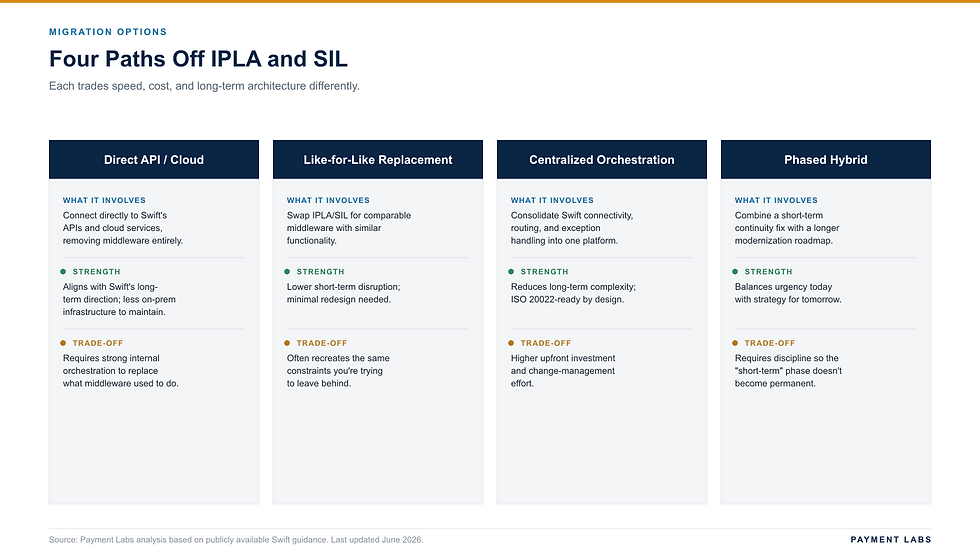
There's no universally correct answer — the right path depends on internal technical capacity, risk appetite, and how much of this transition the institution wants to fold into a broader modernization program versus treating as a standalone replacement. Migration timelines also vary widely in practice: some vendor-led replacements report turnarounds of a few months for simpler environments, while highly customized, multi-system deployments have taken well over a year.
A Step-by-Step Migration Roadmap

1. Audit existing IPLA/SIL dependencies. Map every workflow, message type, and downstream system currently touching IPLA or SIL — not just the obvious Swift connectivity, but AML, sanctions, fraud, treasury, and ERP integrations that may be routed through it.
2. Assess internal capability and bandwidth. Determine honestly whether internal teams have the expertise and capacity to rebuild these integrations in the time available, or whether a migration partner is needed to close the gap.
3. Define the target operating model. Before picking a tool, decide what the payments architecture should look like for the next several years — not just what replaces IPLA/SIL functionally, but how it fits with ISO 20022, instant payments, and API strategy more broadly.
4. Select a migration path. Choose among direct API/cloud connectivity, like-for-like replacement, centralized orchestration, or a phased hybrid approach based on the assessment above.
5. Preserve and migrate existing logic. Rather than rebuilding message-transformation and routing logic from scratch, look for ways to carry forward the institutional knowledge embedded in current workflows — this reduces both cost and the risk of reintroducing bugs that were already solved years ago.
6. Rebuild and test in parallel. Run new integrations alongside the legacy environment, validating message accuracy, routing behavior, and compliance hooks against real production traffic before cutover.
7. Cut over and decommission. Once testing confirms parity (or improvement), move production traffic to the new environment and formally decommission IPLA/SIL — ideally with margin before the June 2026 deadline, not right up against it.
Common Mistakes to Avoid
Treating it as a simple format converter problem. IPLA/SIL frequently orchestrate far more than message translation — underestimating this scope is one of the most common causes of migration delays.
Waiting for a "final" vendor decision before starting the audit. The audit and dependency-mapping work can and should start regardless of which migration path is eventually chosen.
Using short-term patches as a long-term answer. Stopgaps can buy time, but treating them as the destination tends to create compliance and data-quality problems down the line.
Running this as a pure IT project. Because IPLA/SIL often touch compliance and operations, leaving those teams out of planning increases the risk of gaps surfacing late.
Ignoring the ISO 20022 timeline. Migrating IPLA/SIL in isolation, without considering the institution's broader ISO 20022 roadmap, risks having to revisit the same infrastructure again shortly after.
Frequently Asked Questions
What is the SWIFT IPLA retirement deadline? Swift will end support for IPLA (Alliance Access Integration Platform) and SIL (Swift Integration Layer) on June 30, 2026.
What does IPLA stand for in SWIFT? IPLA stands for the Alliance Access Integration Platform — middleware embedded in Swift Alliance Access that handles message translation, routing, and validation between internal systems and the Swift network.
What does SIL stand for in SWIFT? SIL stands for the Swift Integration Layer — standalone middleware that connects internal applications to Swift without requiring changes to those applications.
What is the difference between SWIFT IPLA and SIL? IPLA is embedded within Swift Alliance Access, while SIL is a standalone integration layer that operates independently of it. Both perform similar message-translation and routing functions and are being retired on the same date.
Do all banks need to migrate off IPLA and SIL? Any institution still using either product for Swift connectivity needs an alternative in place by the deadline. Institutions that have already moved to API-based or cloud-native Swift connectivity are not affected.
Is there a grace period after June 30, 2026? No official extension has been announced as of mid-2026. Institutions should plan around the published deadline rather than assume additional time will be granted.
What should be the first step in an IPLA/SIL migration? Start with a full audit of existing workflows and dependencies — including any AML, sanctions, or core banking systems integrated through IPLA/SIL — before selecting a replacement approach.
How long does an IPLA/SIL migration typically take? It varies significantly by complexity. Simpler environments have been migrated in a few months with vendor support, while heavily customized, multi-system deployments have taken over a year.
Does this migration relate to ISO 20022? Yes. The IPLA/SIL retirement is closely tied to Swift's broader push toward ISO 20022 and richer structured data, since legacy middleware struggles to support the format efficiently.
How Payment Labs Helps
Payment Labs works with banks and financial institutions navigating the SWIFT IPLA and SIL retirement — from initial dependency audits through to migration execution and testing. Whether your team needs a second opinion on architecture strategy, hands-on migration support, or help preserving existing integration logic during the transition, we can help you turn this deadline into a foundation for the next decade of payments infrastructure rather than a one-off fire drill.

