
The State of Agentic Payments in 2026: Infrastructure, Protocols, and Strategic Imperatives for Financial Leaders
Executive Summary
By Q3 2026, digital commerce has measurably shifted from Card-on-File to Agent-on-File. AI agents now hold programmable wallets, execute micropayments for API access, and — in a growing number of enterprise pilots — negotiate and settle B2B transactions with limited human intervention. The infrastructure backing this shift is consolidating fast: over $8 billion in payments-related M&A has closed or been announced since early 2026, including Capital One's $5.15 billion acquisition of Brex and Mastercard's $1.8 billion acquisition of BVNK, and the x402 protocol has moved from a Coinbase side project to a 40-member Linux Foundation standard in under a year.
But the infrastructure maturing faster than the economics is precisely where the risk sits. Transaction counts on protocols like x402 are genuinely large — over 200 million to date — yet independent on-chain analysis puts verifiable daily settlement volume in the tens of thousands of dollars, not the scale headline transaction figures imply. For financial leaders, the strategic task in 2026 is separating protocol maturity from economic maturity, and building governance before volume — not after.
This report lays out the current stack, the protocol landscape, a balanced risk assessment, and concrete next steps for fintech and enterprise leaders.
The Macro Shift: Defining Agentic Commerce
Agentic commerce inverts the traditional checkout model. Instead of a human clicking "buy," an AI agent researches, negotiates, and executes a transaction within a policy mandate a human or business has pre-approved.
What's real:
-
Juniper Research projects global B2B payment volumes reaching $224 trillion by 2030, with a growing share expected to be agent-mediated as procurement, freight, and treasury workflows automate.
-
x402 — the leading open protocol for agent-initiated micropayments — has processed more than 200 million transactions across roughly 150,000 endpoints as of August 2026, most under $0.50 per payment.
What needs a discount rate:
-
Transaction count is not transaction value. Independent on-chain tracking of x402 activity has found genuine, non-test settlement running at a small fraction of what issuer-reported headline numbers suggest — reportedly in the tens of thousands of dollars per day. Much of the volume growth reflects testing, gamified demos, and low-value API calls rather than production commerce.
-
The gap between pilot adoption and scaled, high-value enterprise deployment remains wide. Most agentic payment volume today is infrastructure being proven out, not revenue being captured.
The practitioner read: the rails are being built correctly and quickly. The commerce running over them is still early. Leaders should plan on 12–24 months of infrastructure maturation before agent-initiated payments represent a material share of enterprise payment volume.
The 2026 Agentic Payments Stack: A 6-Layer Framework
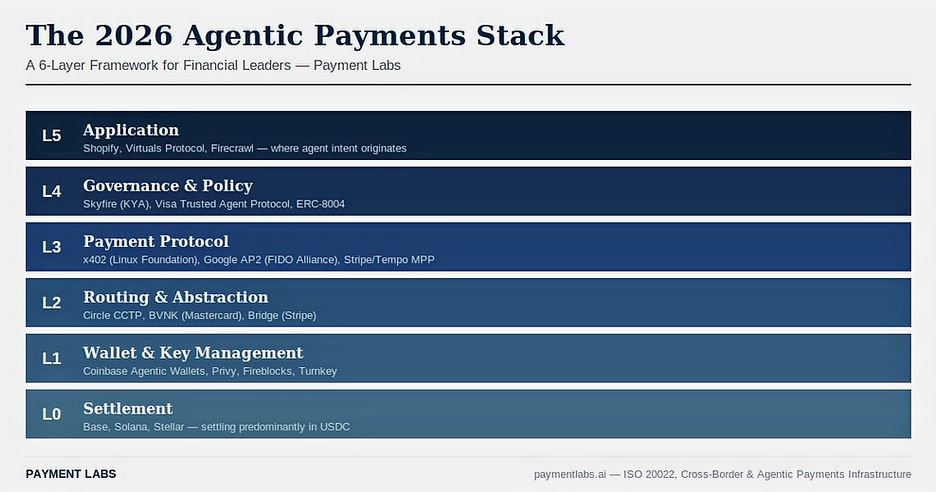
On settlement share: the Base-versus-Solana question is genuinely contested and moves week to week — Solana has recently overtaken Base in weekly x402 transaction count following aggressive throughput and fee advantages, while Base retains the larger cumulative footprint. Treat any single "X% market share" claim as a snapshot, not a fixed fact — verify against current data before citing it externally.
The Protocol Landscape: Consolidation, Not a Single Winner
The market is coalescing around three interoperable — not competing — standards:
x402 Protocol.
Contributed by Coinbase to the Linux Foundation, which launched the vendor-neutral x402 Foundation in July 2026 with 40 founding member organizations, including Visa, Mastercard, AWS, Adyen, Google, Stripe, and the Solana Foundation. It uses the dormant HTTP 402 "Payment Required" status code to embed stablecoin micropayments directly into API calls.
Google's AP2 (Agent Payments Protocol).
Donated to the FIDO Alliance in April 2026 alongside Mastercard's complementary "Verifiable Intent" framework, with more than 60 organizations — including American Express, PayPal, Adyen, and Salesforce — participating in the resulting working groups. AP2 focuses on cryptographically signed "mandates" that prove a human authorized a given agent action, including "human-not-present" purchases.
Machine Payments Protocol (MPP).
Co-developed by Stripe and Tempo, offering payment-method agnosticism across stablecoins, cards, and other rails.
Strategic insight: there will not be one winning protocol. The winning infrastructure will be the interoperability layer that lets an agent route a micropayment through x402 for an API call, use AP2 to prove the human authorized it, and settle a larger B2B invoice through MPP or a bank rail — without the business needing to pick a side.
Balanced Risk Assessment: Opportunities vs. Vulnerabilities

Actionable Recommendations
-
Audit your "agent readiness." Can your payment gateway and fraud stack distinguish agent traffic from human traffic? Evaluate Visa's Trusted Agent Protocol or equivalent bot-management integration before agent traffic becomes material.
-
Pilot stablecoin settlement on a bounded use case. For cross-border B2B payments, pilot USDC settlement via a regulated partner to compress settlement time from days to minutes — before committing to it as a default rail.
-
Build governance first, not last. Establish an L4 governance layer — hard-coded spend caps, merchant allow-lists, human-in-the-loop triggers above a defined threshold — before scaling agent transaction volume, not in response to the first incident.
-
Discount the volume metrics you're handed. When evaluating a protocol, vendor, or partner, ask for genuine settled value, not transaction count. The gap between the two is currently the single most useful signal for separating production infrastructure from demos.