
ISO 20022 Payment Investigations: Automating Exceptions & Accelerating Resolution
Updated: Mar 5
ISO 20022 is fundamentally reshaping payment investigations. With structured messaging and SWIFT's new Case Management platform, financial institutions can cut investigation cycles from days to near real-time — while dramatically improving accuracy and consistency in exception handling.
In a typical payments operations department, between two and five per cent of all payments processed on any given day result in an enquiry, with the cumulative value of affected transactions running into the billions of dollars. As financial institutions face intensifying pressure on their cash management offerings, the cost of handling each individual enquiry has become a critical lever in the competitive landscape.
Managing exceptions and investigations (E&I) remains one of the most labour-intensive activities for financial institutions worldwide. The fundamental problem has long been the widespread use of free-format messages — primarily MT n95, n96, and n99 types — combined with a lack of standardised industry rules. In a best-case scenario, these primarily manual processes mean exceptions consume a minimum of six working days to resolve. The November 2025 end of the MT/ISO 20022 coexistence period, and the SWIFT Case Management milestones running through to 2027, are set to change this entirely.

Where We Are: End of Coexistence and What It Means for E&I
On 22 November 2025, SWIFT ended support for MT payment instruction messages, marking the close of the coexistence period that began in March 2023. But this milestone is only the beginning of a deeper transformation. The migration of Exceptions & Investigations messaging to ISO 20022 follows a separate, structured roadmap extending to November 2027 — and this is where the real operational change lies for payments teams.
⚠️ Critical distinction: While MT payment instruction messages (MT103, MT202, etc.) were retired in November 2025, legacy E&I messages — MT195/295, MT196/296, MT199/299 — remain in use until November 2026 and 2027 respectively. Institutions must not conflate these timelines.
SWIFT's new Case Management service, launched in November 2024, is the central mechanism for the E&I transition. By replacing point-to-point, unstructured MT messaging with a centralised, orchestrated service, it introduces structured ISO 20022 messages (camt.110 and camt.111), a smart routing layer, and accessible channels via API or GUI — fundamentally automating what were previously manual, bilateral enquiry chains.
SWIFT Case Management — Investigation Flow
A key feature of the new architecture is that camt.110 and camt.111 messages are never exchanged directly between banks. Instead, they are always routed through the Case Orchestrator (BIC: TRCKCHZZ), which acts as a smart router — automatically ensuring that investigation messages are delivered to the correct institution, eliminating the manual chasing and bilateral coordination that characterises today's MT-based processes.
The E&I Migration Roadmap: Key Mandatory Milestones
SWIFT has published a detailed, phased roadmap for E&I migration as part of the CBPR+ post-November 2025 programme. Understanding these hard deadlines is essential for operational planning.

Legacy MT Messages and Their ISO 20022 Replacements
The following table maps the legacy free-format MT messages being retired to their structured ISO 20022 equivalents within the Case Management framework. Institutions must plan system upgrades and workflow reconfigurations around these replacements.
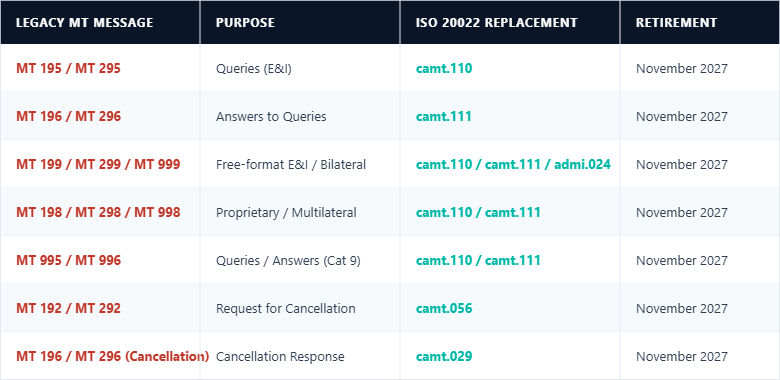
ℹ️Important: SWIFT conversion of MT 9xx messages to ISO 20022 camt.xxx is not possible. Institutions are responsible for their own mapping and system upgrades for category 9 messages. MT199/299 used to update the Tracker are deprecated but supported beyond November 2026 — institutions are strongly encouraged to switch to TRCK messages or the API immediately.
Understanding Exceptions & Investigations: The Four Core Types
A case is created each time an E&I process is required. This file — electronic or otherwise — records the progress of an investigation and is managed by the initiating party. The assignment and exchange of messages between collaborating parties must follow a defined set of rules; with ISO 20022 and Case Management, these steps become fully automatable for the first time.
An exception or investigation process is triggered when a problem occurs in the normal execution of a payment transaction. The problem can relate to processing errors, missing information, unreconciled entries, or failures to receive expected funds. The four investigation types that went live with the November 2024 Case Management launch are:

Additional investigation types — including modification requests and cover non-receipt scenarios — are expected to be introduced through Case Management in 2026 as the mandatory scope expands.
How SWIFT Case Management Transforms E&I Operations
The shift from bilateral MT messaging to centralised Case Management is not just a technical change — it represents a fundamental operational transformation for payments teams. Here is what changes:
As-Is : MT-Based E&I (Legacy)
Free-format text messages exchanged bilaterally between institutions. No standardised structure, no automation-friendly data fields. Each investigation requires manual interpretation, routing decisions, and follow-up. Average resolution: 6+ working days. High operational cost per enquiry; no centralised visibility.
To Be: ISO 20022 Case Management
Structured camt.110/111 messages with defined, machine-readable data fields. Centralised orchestration via Case Orchestrator (TRCKCHZZ) automatically routes to the correct institution. APIs and GUI provide direct access without IT setup. Built-in in-flow translation during the transition period supports legacy counterparties. Resolution accelerated toward near real-time for automated cases.
The richer data embedded in ISO 20022 messages is foundational to this transformation. Structured party information, unique end-to-end references, and standardised purpose codes allow systems to automatically match, route, and in many cases resolve investigations without human intervention. This directly reduces the labour-intensive burden that has historically made E&I a major cost centre for payment operations departments.
What Financial Institutions Need to Do Now
With November 2026 as the next hard mandatory deadline for Case Management, institutions must act with urgency across several workstreams:
Assess current E&I workflows. Map all internal processes that rely on MT n95/n96/n98/n99 messages. Identify which case types they handle, which counterparties they interact with, and where manual touchpoints exist. This baseline is essential before any system changes.
Subscribe to Case Management and begin testing. The service is already available on an opt-in basis with GUI access requiring no IT setup. Institutions can begin familiarising teams with the new service immediately using existing channels. The early adopter programme for messaging and API integration has been running since 2025.
Upgrade core systems for camt.110/111. Modify internal systems to generate, parse, and process the new message formats. Align message identifiers, case references, and reconciliation logic with the ISO 20022 data model. Ensure mandatory receipt status is enabled for all received pacs.008 messages.
Plan for address structure migration. Structured and hybrid postal address formats are mandatory from November 2026. Cleanse customer and counterparty address data now — unstructured-only addresses will be rejected (NAK) from that point. This is a larger data exercise than many institutions anticipate; AI-assisted tools can help with reformatting but validation remains essential.
Stop using MT199/299 for Tracker updates. These were deprecated in November 2025. Switch to TRCK messages or the SWIFT API as the authoritative method for confirming payment processing into the GPI Tracker.
🕐Don't wait for 2026. SWIFT will run an automatic RMA (Relationship Management Application) bootstrap in November 2026 to enforce mandatory receipt status. But operational readiness — workflow redesign, staff training, system testing — requires months of lead time. Institutions that begin now will avoid costly fire-fighting and protect their customers from disruption.
The Strategic Case: From Compliance to Competitive Advantage
For too long, E&I has been viewed purely as a cost — a necessary overhead of the payments process. ISO 20022 and Case Management fundamentally alter this equation. The shift to structured data and automated workflows creates the conditions for activity-based pricing models, where payment investigations become a separately invoiced, high-value service rather than an undifferentiated operational burden.
Institutions that migrate E&I workflows to ISO 20022 ahead of the mandatory deadlines will benefit from lower per-enquiry costs, higher STP rates, and the ability to offer clients demonstrably faster resolution times. In a market where cash management service quality is a core retention factor, this is a genuine differentiator.
SWIFT's Data Quality Analytics tool — purpose-built for ISO 20022 — supports this journey by giving institutions visibility into how well their payment messages perform in terms of completeness, consistency, and richness. Small improvements in data quality translate directly into fewer investigations in the first place, compounding the operational efficiency gains.
Frequently Asked Questions: ISO 20022 Payment Investigations & SWIFT Case Management
What is SWIFT Case Management and when did it launch?
SWIFT Case Management is a centralised service that replaces bilateral, free-format MT messaging for payment exceptions and investigations with structured ISO 20022 messages (camt.110 and camt.111). It launched in November 2024 on an opt-in basis. All investigation requests and responses are routed through a central Case Orchestrator (BIC: TRCKCHZZ), enabling automation and near real-time resolution for the first time.
What ISO 20022 messages replace MT195, MT196, and MT199?
MT195 and MT295 (queries) are replaced by camt.110. MT196 and MT296 (answers to queries) are replaced by camt.111. Free-format MT199, MT299, and MT999 messages used for bilateral E&I are replaced by camt.110, camt.111, and admi.024. All legacy MT E&I messages are retired in November 2027.
When must financial institutions start using camt.110 and camt.111?
From November 2025, institutions are obligated to begin sending camt.110/111 for supported investigation types. From November 2026, all financial institutions must be capable of receiving camt.110 investigation requests through Case Management. Full send and receive capability via ISO 20022 exclusively over FINplus is mandatory from November 2027, when in-flow MT translation support ends entirely.
What are the four initial E&I case types supported in SWIFT Case Management?
The four case types live from November 2024 are: Creditor Claim Non-Receipt (CCNR), Creditor Agent Claims Cover Non-Receipt (CONR), Unable to Apply (UTAP), and Request for Information (RQFI). Additional investigation types — including modification requests — are expected to be introduced as the mandatory scope expands toward November 2026.
What replaces MT192/MT292 payment cancellation requests under ISO 20022?
MT192 and MT292 (Request for Cancellation) are replaced by camt.056, while MT196/MT296 cancellation responses are replaced by camt.029. From November 2026, all payment cancellation requests and responses must be exchanged through SWIFT's Stop and Recall / Case Management service over FIN or FINplus. By November 2027, camt.056/camt.029 over FINplus becomes the only permitted channel.
What happens to unstructured postal addresses after November 2026?
From November 2026, payment messages containing unstructured-only postal addresses will be rejected (NAK) by SWIFT. Financial institutions must ensure all customer and counterparty address data is migrated to structured or hybrid ISO 20022 address formats before this deadline. This data cleansing exercise is often more complex than anticipated and should begin immediately.
What is the difference between camt.056 and camt.029?
camt.056 is the ISO 20022 message used to initiate a payment cancellation request — replacing the legacy MT192/MT292. camt.029 is the resolution response to that request, confirming whether the cancellation was accepted, rejected, or pending — replacing MT196/MT296 in the cancellation flow. Both must be exchanged through SWIFT's Stop and Recall service from November 2026.
How does SWIFT Case Management improve exception resolution times?
Legacy MT-based E&I relied on free-format, bilateral messaging with no standardised structure, resulting in a minimum of six working days to resolve a typical exception. SWIFT Case Management introduces structured camt.110/111 messages with machine-readable data fields, automatic routing via the Case Orchestrator, and API/GUI access — enabling straight-through processing and near real-time resolution for automated case types.
About Payment Labs
Payment Labs is a specialist financial technology firm helping banks, PSPs, and corporates navigate the ISO 20022 migration. Our Nucleus ISO 20022 Data Fabric platform provides end-to-end data transformation, address enrichment, and compliance automation for SWIFT CBPR+, SEPA, and domestic payment schemes.
For E&I workflow assessments, Case Management onboarding support, contact our ISO 20022 advisory team.
Last updated: March 2026 | Payment Labs ISO 20022 Compliance Series

